
BRAND STRATEGY · A PRACTICAL PLAYBOOK
Build your brand’s Taste Profile: a practical guide to HubSpot’s LOOP prompts
Turn customer evidence and your company’s stories into an approved reference for better AI-supported content.

· 10 min read
THE SHORT ANSWER
How do you build a LOOP Taste Profile?
Gather permitted customer evidence, organize it into the six Customer Taste dimensions, then develop four Brand Taste stories: brand, product, thought leadership and customer. Review the combined profile, pressure-test one asset and update it from real feedback. This guide adapts HubSpot’s prompts and adds evidence checks, ownership and human review.
I'm listening to Loop: Outlearn. Outmarket. Outgrow. by Kipp Bodnar and Kieran Flanagan (Forefront Books, September 22, 2026), and I wanted to look closely at the prompts behind their Taste Profile.
HubSpot publishes the prompt library and a completed example. We can see what information goes in, how it is organized and how the profile is used to develop content.
The process starts with customers: the language they use, the situations they face and the things that make them trust or dismiss a message. It then adds four stories about the brand, the product, the company's point of view and the customer experience.
My read is that the useful work happens before the draft. A team has to explain its choices and decide which claims it can support. The prompts help organize that work, but they cannot supply customer evidence the team does not have.
Recent research points the same way. Bain's 2026 survey of 1,397 executives (September 30, 2026) found that only 6% of marketing organizations say AI delivers significant performance impact, and that the leaders were 3.7 times more likely than laggards to fully redesign workflows around AI. BCG described a CPG company (September 29, 2026) whose brief-writing agent rose from 50% accuracy to more than 90% after the company codified how its best marketers developed briefs.
Here is how I would test the process on one upcoming article.
Why HubSpot developed LOOP
HubSpot introduced Loop Marketing on September 3, 2025, at its INBOUND 2025 conference, responding to fragmented attention and changes in search. Its announcement kept inbound's principles of education, value and relationships while proposing a different way to create, distribute and learn.
On episode 455 of their Marketing Against the Grain podcast, released September 22, 2026, Bodnar and Flanagan discussed how HubSpot lost 140 million visits in one year while increasing demand generation by 20%. These figures are self-reported by HubSpot, and they do not show that LOOP caused the improvement. Still, it is useful to hear a company so closely associated with inbound marketing explain how it was adapting its own approach.
LOOP has four stages: Express, Tailor, Amplify and Evolve. The Taste Profile begins in Express, where a team defines what it wants to say and to whom. The same profile can then inform content adaptation, distribution and learning.
This guide focuses on building and testing that profile. It follows the companion prompts in chapters 5 to 7, with my suggested review steps added.
Choose the first task
For the walkthrough, suppose a distributor wants to write an article for procurement managers who struggle to get dependable order updates.
This is an illustrative example. It does not describe a customer case or make a claim about a particular company.
The article will explain what buyers should ask a supplier about order visibility and escalation. It should help a procurement manager evaluate a process, whether or not they choose this distributor. That gives the profile a specific audience and an immediate use.
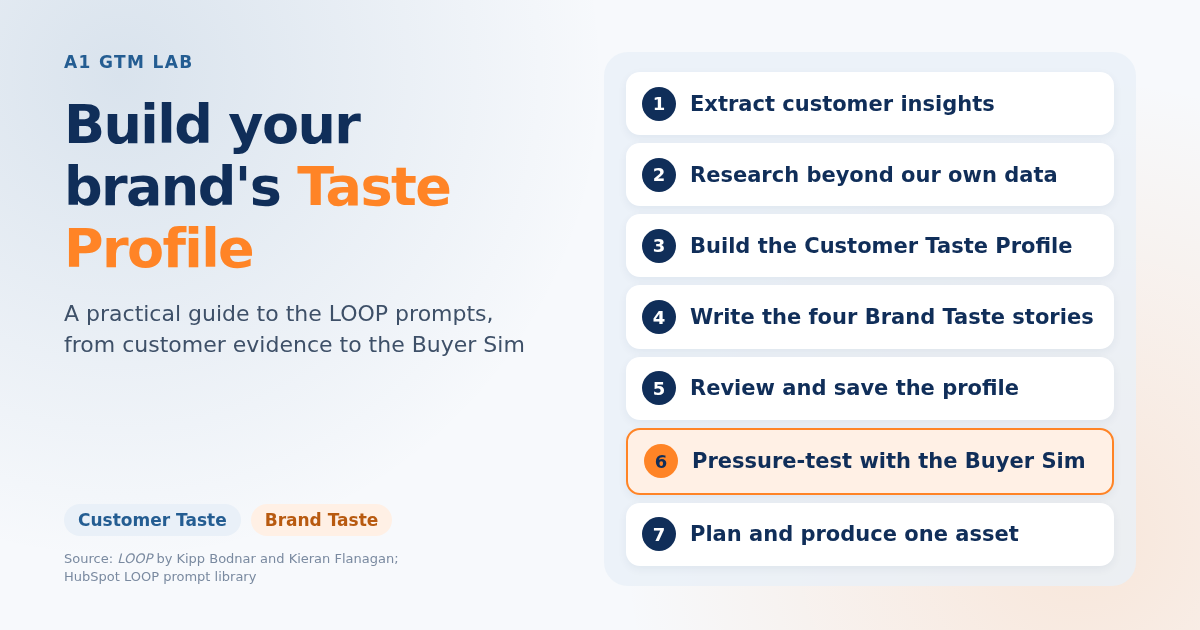
1. Extract insights from customer data
Start with HubSpot's "Extract Insights from Customer Data" prompt (chapter 5).
The input should contain evidence the team is permitted to use: interview notes, sales-call excerpts, support questions, win/loss records and relevant reviews. Use approved tools, remove unnecessary personal information and keep source links.
For our distributor example, we would look for descriptions of what happens when an order changes. Who needs an answer? What information is missing? What happens when the answer arrives late?
Create a record for each observation:
The customer's exact words.
Where and when the statement appeared.
The customer's role and situation, where known.
Our interpretation.
What we still need to check.
Keep the interpretation separate from the quotation. A comment about one late shipment does not establish that every buyer has the same problem.
2. Research what the existing evidence does not cover
Next is "Research Your Customer" (chapter 5). The prompt points to review sites, Reddit, LinkedIn, industry forums and competitor content to understand how the audience describes its work and responds to marketing.
For the distributor example, we might examine public discussions about order visibility, supplier communication and escalation. We would record the source and date of each one, instead of asking AI to summarize from memory what procurement managers think.
Public comments have limits. A forum participant may not belong to our target segment, and visible complaints may not represent the wider audience. If we cannot establish someone's role, we should say so.
3. Build the six-part Customer Taste Profile
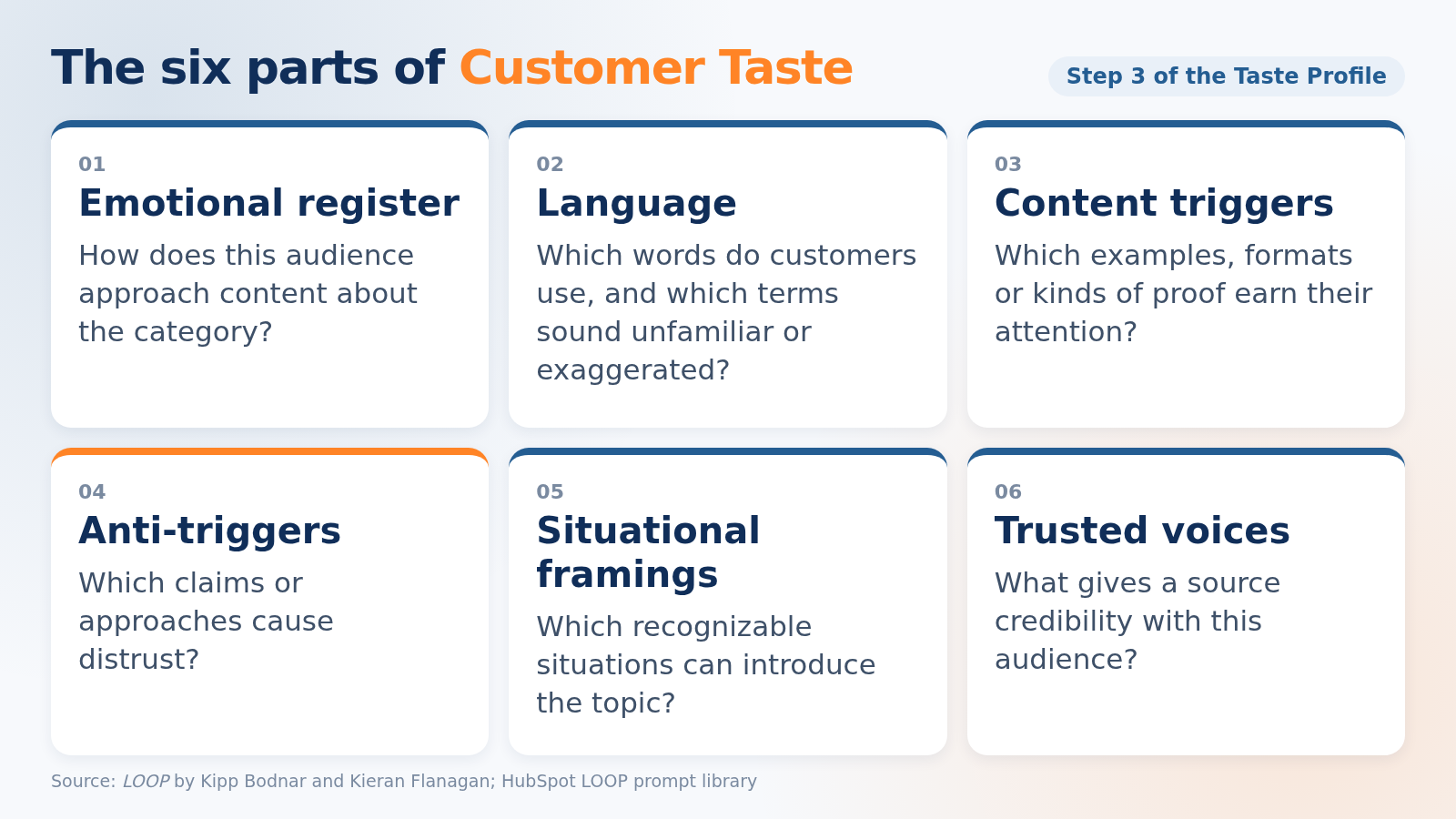
Use "Build the Customer Taste Profile" (chapter 5) with the evidence collected so far. HubSpot organizes it into six sections:
Emotional register: How does this audience approach content about the category? Record evidence instead of assigning emotions based on a job title.
Language: Which words do customers use, and which terms sound unfamiliar or exaggerated?
Content triggers: Which examples, formats or kinds of proof earn their attention?
Anti-triggers: Which claims or approaches cause distrust?
Situational framings: Which recognizable situations can introduce the topic?
Trusted voices: What gives a source credibility with this audience?
In our example, a possible situation is a procurement manager preparing an internal update while waiting for confirmation from a supplier. We would include it only if research supports it.
The profile should tell a writer what to do differently. "Our customers value transparency" offers little direction. "Show which information the buyer can see, who confirms it and what happens when it changes" gives the writer something to explain.
4. Develop the four Brand Taste stories
Chapter 6 provides a separate prompt for each story: "Write Your Brand Story," "Write Your Product Story," "Write Your Thought Leadership Story" and "Build Your Customer Story." Marketing may organize the material, while product, sales, operations and customer-facing teams can help verify it.
Brand story: Explain the problem the company exists to address and the conviction behind its work. Avoid inventing an origin story or a personal motivation just because it would make the narrative stronger.
Product story: Explain the approach the company chose, its trade-offs and why a buyer would choose it. For our distributor, document how order updates work, who owns exceptions and what response commitments exist. If the company cannot support a proposed claim, leave it out.
Thought leadership story: Describe a defensible belief about the market, grounded in experience or evidence. One possible position: buyers should evaluate how suppliers handle exceptions alongside price and delivery estimates. The team would need evidence to explain it.
Customer story: Examine what customers say in public sources, including praise and criticism, and compare that with the company's preferred narrative. Perhaps the distributor emphasizes technology while buyers repeatedly mention a responsive account manager. We would want to understand that difference before producing more content.
Keep the current customer experience separate from the experience the company hopes to provide next year.
5. Review and save the combined profile
Now we have Customer Taste and the four Brand Taste stories. My addition is a review before using them in production: check quotations, product claims and interpretations with the relevant owners. Mark unresolved questions so the profile does not sound more certain than the evidence.
Save the approved profile with its audience, intended uses, source links and dates, named owner, review date, approved claims and access restrictions.
Check how the selected AI tool receives updates. Uploading a document once does not ensure the tool will use a revised version later.
6. Pressure-test the story with the Buyer Sim
Two chapter 6 prompts, "Activate Your Buyer Sim" and "Pressure-Test a Story with the Buyer Sim," use the profile to critique content.
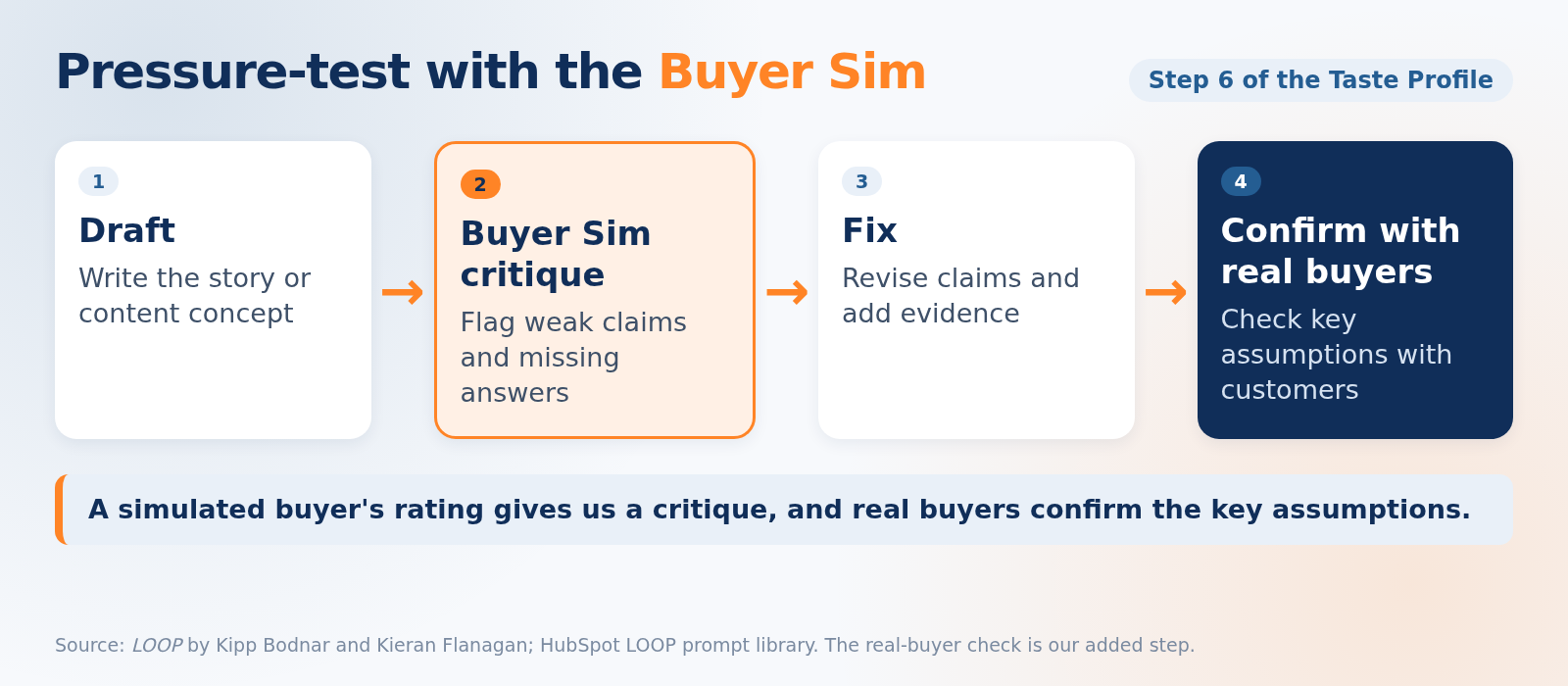
For our distributor article, this could surface questions such as: What happens when the supplier cannot confirm a delivery date? Who updates the buyer? What evidence supports the service promise?
Those are useful questions to investigate. A simulated buyer's rating is not evidence that procurement managers will trust the article or take action, so I would use the critique to prepare questions for real readers and then check consequential assumptions with customers.
7. Use the profile to plan and produce one asset
Chapter 7 moves from the profile into content planning. "Build Your Content Game Plan" helps choose which stories to emphasize and where AI may be useful. "Audit Your Content Vault" examines existing material for angles and evidence.
For our example, that could mean reviewing an approved service process and customer questions before choosing the article's structure. "Generate Content Concepts" can then suggest ways to explain the issue to the selected audience, and "Pressure-Test Concepts with the Buyer Sim" can critique those concepts before we commit to one.
Before approving the article, check:
Does it describe a situation supported by research?
Can we trace each factual and product claim to a source?
Does it explain the company's approach clearly?
Does it give the reader something usable?
What would a knowledgeable reviewer challenge?
After the anchor article is approved, "Atomize Anchor Content Across Formats" can help adapt it for other channels. Keep the same factual boundaries, and reconsider the format and the reader's next step for each channel instead of copying identical text everywhere.
What this can change about AI-generated content
The profile gives a writer or AI tool more specific material: a recognizable customer situation, supported product claims, a point of view and examples of language that fits.
That can reduce generic substitutions. It does not guarantee accurate reasoning, original ideas or a shorter approval process.
For a first test, compare similar pieces with and without the profile. Record reviewer time, revision rounds, factual corrections and total time to approved publication. Check audience response separately once the content has been used.
If reviewers keep correcting the same product claim, update the source or the profile. If real customers reject an assumption, revise it. If an AI tool ignores approved material, investigate that before producing more drafts.
The first result I would look for is a draft that needs fewer repeated explanations and gives the reader a clearer answer. Once we can see what improved, we can decide how to use the process more broadly.
The Taste Profile in 7 steps

Frequently asked questions
What is a LOOP Taste Profile?
A LOOP Taste Profile combines Customer Taste with Brand Taste. It organizes audience evidence and four company stories into a reference for creating and reviewing marketing content.
What is the difference between Customer Taste and Brand Taste?
Customer Taste covers emotional register, language, content triggers, anti-triggers, situational framings and trusted voices. Brand Taste covers the brand, product, thought-leadership and customer stories.
What information do you need to build a Taste Profile?
Start with permitted customer interviews, sales-call excerpts, support questions, reviews, win/loss research and current product information. Keep source dates and quotations separate from interpretations, and mark missing evidence.
Does a Taste Profile eliminate AI slop?
No. Specific customer situations, supported claims and a clear point of view can reduce generic output, but a profile does not guarantee accuracy or originality. Human review and real customer feedback are still needed.
Can Buyer Sim replace customer research?
No. Buyer Sim can critique a story or concept and generate questions. Its output is a simulation, not observed buyer behavior or evidence of conversion. Validate important assumptions with real customers.
How can a team test the LOOP prompts?
Choose one audience and one article or email. Build and approve a profile, apply it to the asset, then compare review time, revision rounds and factual corrections with similar work. A small pilot provides directional learning, not proof of causation.
Sources and further reading
- HubSpot: Loop Marketing framework
- HubSpot: LOOP book prompt library
- HubSpot: Sample Taste Profile
- HubSpot: Blog traffic explanation
- HubSpot: LOOP announcement, September 3, 2025
- Marketing Against the Grain, episode 455
- Bain: AI in Marketing: How Leaders Achieve Double the Revenue Impact
- BCG: How AI rewrites CPG marketing economics
- BCG: Composable shelf for agentic marketing
Kipp Bodnar and Kieran Flanagan, Loop: Outlearn. Outmarket. Outgrow., Forefront Books, September 22, 2026. ISBN 9781637636107.
Bain’s figures are survey findings; BCG’s example is a reported company case. Neither establishes a guaranteed outcome for this playbook.
KEEP EXPERIMENTING
Get the next experiment in your inbox.
Join Curiosity Insights for practical AI and GTM experiments, research and lessons from the Lab.
Sign up for the newsletter →Choose to subscribe. Unsubscribe anytime.