
AI ECONOMY · CURIOSITY INSIGHTS
If AI agents boost supply, who is left to buy?
A company can lower the cost of doing work and still face a harder question: can its customers afford to buy what it produces?

· 6 min read
THE SHORT ANSWER
How could AI agents change supply and demand?
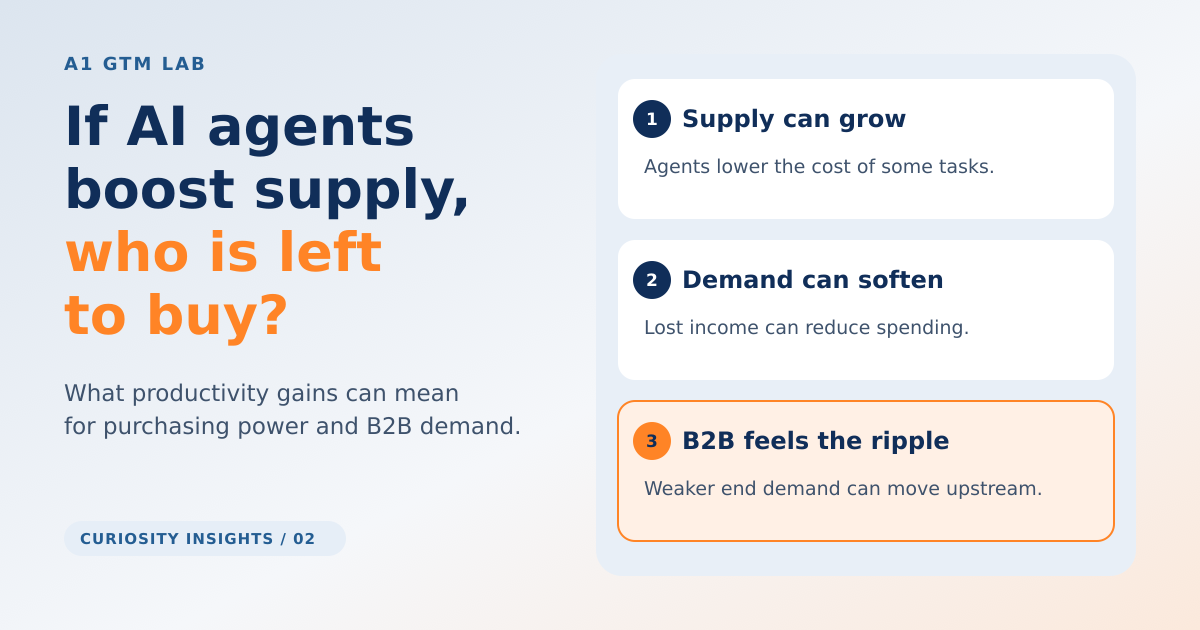
AI agents can make some tasks cheaper and let companies produce more. If lost income isn’t offset by lower prices, new jobs or other sources of spending, demand may not keep up. That can put pressure on prices and margins and travel upstream to B2B sellers. It’s a scenario to test, not a prediction of mass unemployment or economy-wide deflation.
From one company’s point of view, the case for automation is straightforward: if an agent can handle a task reliably at lower cost, the team can get more done. The economics still depend on the task. In June 2026, U.S. private-industry benefits averaged $14.07 per hour worked, or 30% of employer compensation. That measures what firms spent on benefits, not what they could save by replacing a job. An agent also carries costs, including software, integration, oversight and rework. Compare the full cost per acceptable result.
Now zoom out. One company’s wage bill is somebody else’s income. When many firms automate at once, some of the gains may reach households through lower prices, better-paying work or new sources of income. If those offsets don’t keep up with lost earnings, who buys the extra output?
What do the 2026 labor data actually show?
- U.S. job-cut announcements: U.S.-based employers cited AI in 121,401 of the 617,189 announced cuts Challenger tracked from January through October 2026, about 20%. October alone accounted for 1,265 AI-cited cuts, the lowest monthly figure that year through October. These are announcements and employer-stated reasons, not a count of confirmed AI-caused layoffs or a share of all U.S. layoffs.
- U.S. labor share: In its September release, the Bureau of Labor Statistics reported that workers received 52.8% of nonfarm business output as compensation in Q2 2026, the lowest in that series at the time. Real hourly compensation was down 0.1% from a year earlier. Those figures don’t tell us how much, if any, of the shift came from AI.
- Hiring among younger workers in France: Banque de France researchers found that permanent-contract hires among 21- to 29-year-olds in the most AI-exposed occupations were roughly 28% below November 2022 levels in March 2026, compared with 8% below in the least-exposed occupations. The authors also found no significant difference in overall employment levels between intensive AI users and other firms. The hiring comparison doesn’t isolate AI as the cause.
- U.S. employer contacts: In the October Beige Book, five of the Federal Reserve’s 12 districts reported that some firms reduced staff through attrition, delayed hiring or expected to create fewer jobs after investing in AI. That’s qualitative evidence, not a national estimate.
Together, these are reasons to watch how companies hire and how productivity gains are shared. They don’t establish that household demand has already fallen because of AI.
Would more supply and weaker demand lower prices?
If sellers can produce more while customers can’t or won’t buy more at current prices, sellers may discount, cut production or accept lower margins. That puts downward pressure on prices in those markets. Disinflation means prices rise more slowly; deflation means the overall price level falls. Neither follows automatically from cheaper production in one sector.
Some prices can also rise while others ease. In September 2026, Fed Governor Lisa Cook described near-term inflationary pressure from AI investment and anticipated that broader productivity gains could modestly slow inflation over the next few years. That was her assessment, not a guaranteed outcome. The balance depends on where investment strains supply, how much competition passes savings through, and whether households share in the gains.
How can weaker consumer demand reach B2B sellers?
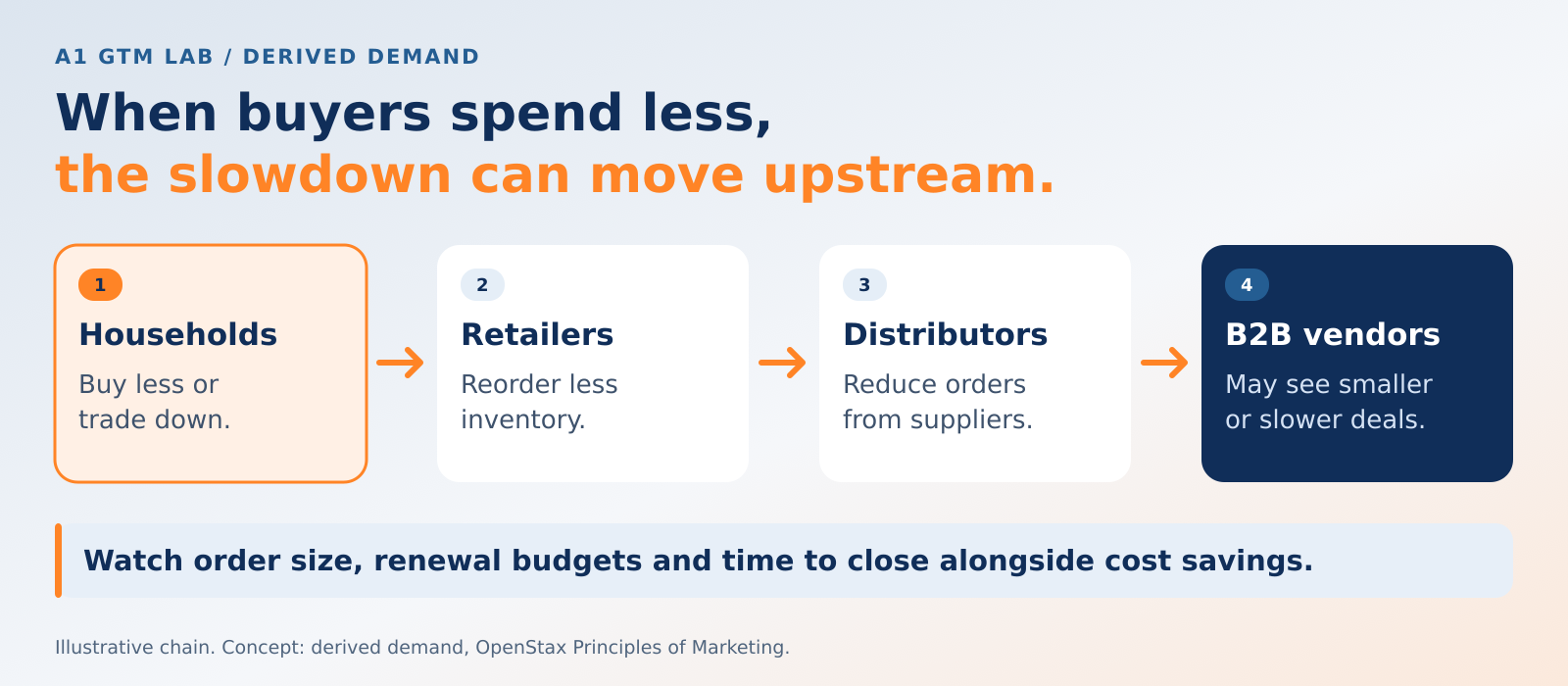
Derived demand means demand for a business input depends on demand for the product or service it helps deliver. OpenStax’s marketing textbook explains the connection between consumer markets and B2B demand. Think of a retailer ordering fewer units after shoppers trade down, a distributor cutting its next order, and a vendor seeing a smaller renewal or a slower deal. Not every B2B chain ends with a household; trace yours to whoever ultimately funds or uses the product, including public or institutional buyers.
Could people earn with agents they control?
One proposal is for governments to support household income. In a September 2026 interview, Elon Musk called his prediction “universal high income” and pictured a single person working with many robots. That’s a prediction, not evidence about what people will earn. A different question is whether an individual could control the agents doing the work and keep a share of the value they create.
Picture a freelance marketer who uses agents to research, prepare reports and handle routine campaign operations. The marketer still reviews the work, signs the client agreement and gets paid. Can they take on more projects without sacrificing quality or spending the gains on software and rework? That’s something a person can test now. It does not show that one person can reliably replace three jobs, keep their previous pay or make up for lost income across the economy.
Payments show one piece of the infrastructure. Mastercard described how Skyfire’s Know Your Agent technology can help identify an agent and whom it represents. In October, Visa, BILL and Billtrust announced a live pilot in which authenticated agents execute supplier invoice payments that buyers have already approved. These are examples of delegated spending, not proof that agents can earn independently or that workers will capture the returns.
Who controls what a personal agent can do?
Personal control has to mean more than putting a human name on a platform account. An agent should have its own identifiable credentials, a narrow set of permissions, a visible activity log and an easy way for the person to revoke access. NIST’s design tenets describe separate agent identities and traceable delegation that cannot expand beyond the original authority. They are design guidance, not a binding rule. The FTC has also sought public input on platforms’ role in impersonation scams, a separate effort focused on scam ads, not a general law protecting personal-agent identity. That leaves a question beyond technical controls: what recourse would people have if a platform misuses an agent’s delegated authority? Before delegating payments, check who can stop or dispute an out-of-scope transaction.
What should GTM teams do now?
- Measure what gets better. Track accepted output, human review time and cost per accepted result, not just tasks automated.
- Follow the money to the end buyer. Put one end-market signal next to cost savings in the ROI model. In a retail-linked chain, use sell-through or reorder volume where you have it. For your own pipeline, compare deal size, time to close and renewal budgets.
- Keep a path into the work. Pair agent training with entry-level assignments where people can still learn to exercise judgment and check quality.
- Give each agent clear limits. Name the person accountable, log consequential actions, set spending limits where relevant and test how fast access can be revoked.
The practical question isn’t only “How much more can we produce?” It’s “Who funds the demand for it, and how would we notice if that demand changed?”
For a practical example of measuring quality before scaling a workflow, read the Lab’s guide to building and testing a LOOP Taste Profile.
Sources
- U.S. Bureau of Labor Statistics: Employer Costs for Employee Compensation, June 2026
- Challenger, Gray & Christmas: October 2026 Job Cut Announcement Report
- U.S. Bureau of Labor Statistics: Q2 2026 Productivity and Costs, September release
- Banque de France: Generative AI and hiring among young people
- Federal Reserve: October 2026 Beige Book, national summary
- Federal Reserve: Governor Lisa Cook on AI and the economy, September 28, 2026
- OpenStax Principles of Marketing: The Business-to-Business Market
- China Media Group: September 22, 2026 interview with Elon Musk (transcript)
- Mastercard: Know Your Agent and Agent Pay
- Visa: Live pilot with BILL and Billtrust, October 20, 2026
- NIST: Design Tenets for Agent Identity Management Systems
- FTC: Advance notice on platforms and impersonation scams