AGENCY STRATEGY · CURIOSITY INSIGHTS
Will AI leave us with fewer marketing agencies?
What Gartner’s 15% forecast tells us about consolidation, specialist firms, and how many clients an agency can serve

· 4 min read
THE SHORT ANSWER
Does Gartner predict fewer agencies?
Gartner forecasts a smaller share of marketing budgets going to agency fees, not a smaller number of agencies. Some brands may consolidate work with lead agencies. Others may hire independent specialists by project, and AI could help those firms serve more clients if it saves time from kickoff through approval.
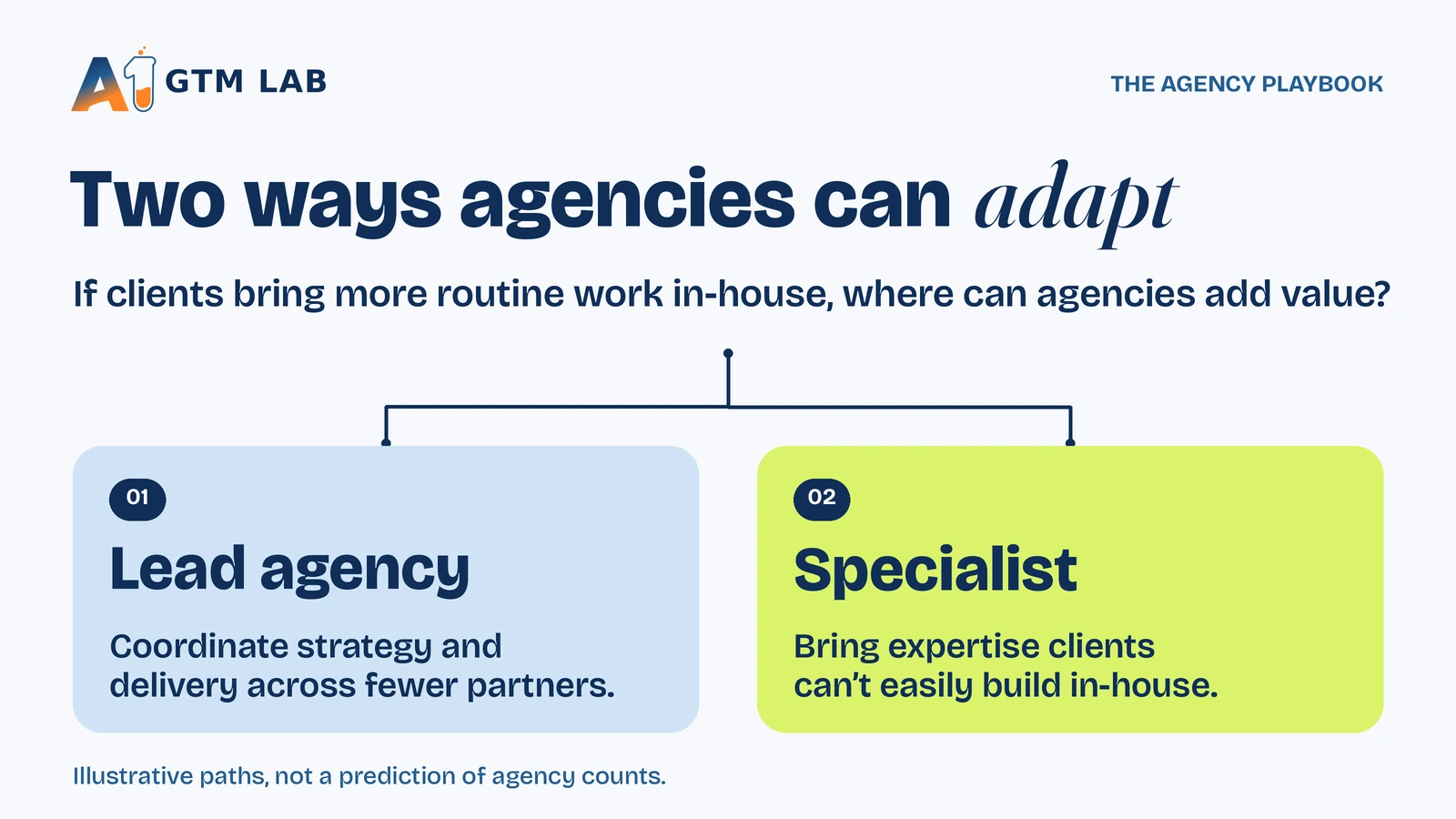
When I read Gartner’s forecast, I wondered if we’d end up with fewer agencies. If brands bring more work in-house and cut overlapping contracts, some firms may have to merge, specialize, or close. But AI also changes what a small team can take on. What if a specialist can serve more companies without needing to become part of a bigger agency?
My bet is that we’ll see both. Some brands will consolidate work with a lead agency. At the same time, small specialists can grow if they make the full client engagement easier to deliver. The agencies I’d worry about most are the ones whose clients can now do much of the same work themselves.
What does Gartner’s 15% forecast actually tell us?
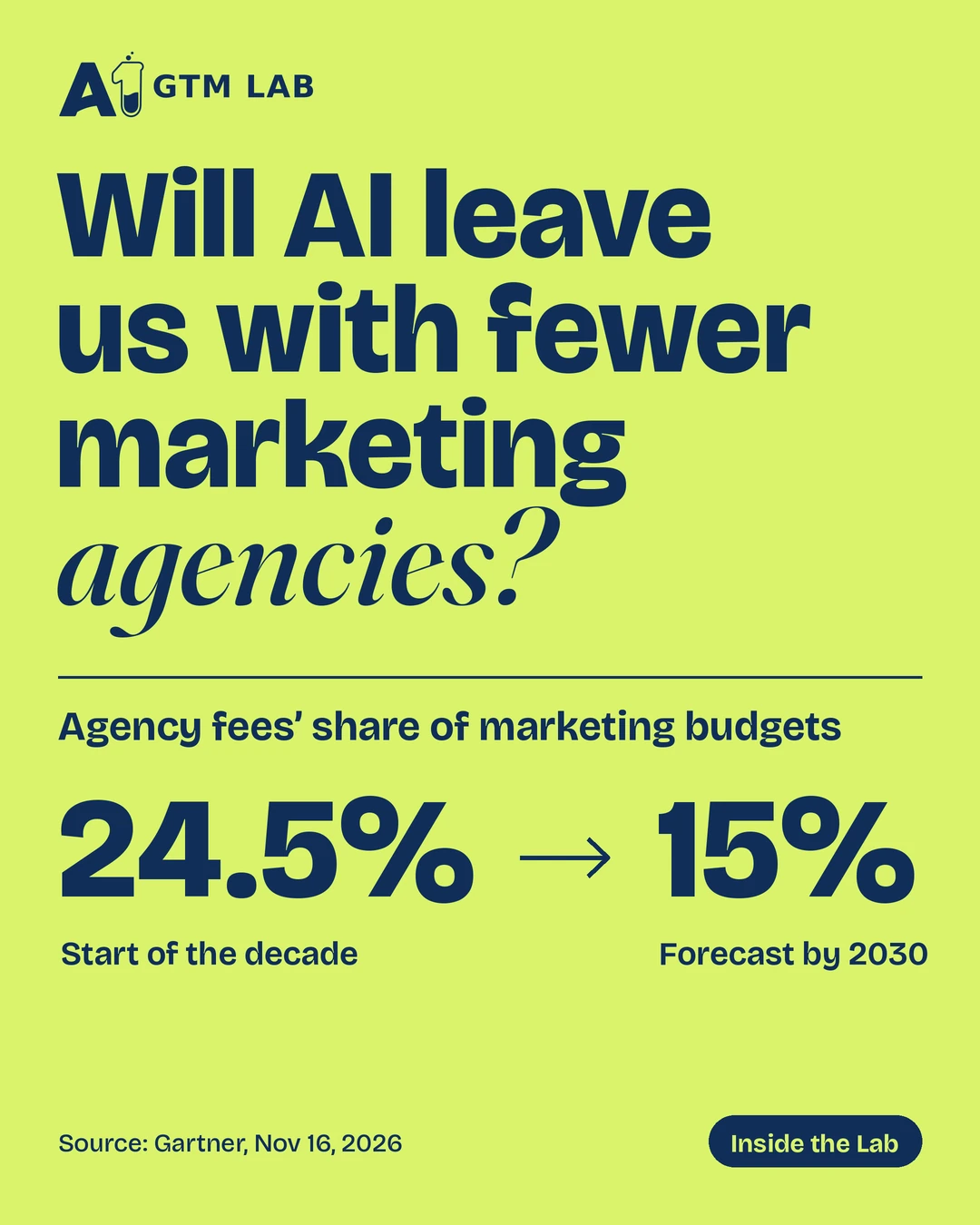
In its November 2026 public Q&A, Gartner predicts that agency fees will fall from 24.5% of marketing budgets at the start of the decade to 15% by 2030. That’s a 9.5 percentage-point decline in budget share. Gartner points to automation, more work moving in-house and pressure on marketing budgets. A smaller share can mean fewer dollars when budgets are flat, but the forecast itself doesn’t tell us how many agencies will survive.
I’d separate three questions: Will a brand keep fewer agency partners? Will there be fewer independently owned agencies? Can each agency serve more companies? A brand can move from four standing retainers to one lead partner and still bring in an independent researcher or a category specialist for a launch. Its permanent roster shrank. That doesn’t tell us how many firms are in the market.
Why some agencies will get bigger
For a brand operating across countries, one lead agency can handle procurement, reporting and coordination across markets. A merger can give that agency capabilities and client relationships it would take years to build. Omnicom’s acquisition of Interpublic in 2025 shows what consolidation of ownership looks like. It doesn’t tell us that AI caused the deal or that every agency needs one.
There’s evidence of pressure on the buyer side, too. In Gartner’s 2025 CMO survey, 39% of respondents planned to cut agency budgets. Dropping underperforming relationships and simplifying rosters were among the main things they planned to do. That’s evidence of intent to consolidate work, not a count of agencies that closed.
How a small agency could serve more companies
Imagine a boutique B2B agency that runs customer interviews and turns them into positioning and launch plans. AI can accelerate transcription, evidence tagging and draft variations. The team can reuse the workflow across clients while keeping the conclusions specific to each company. A repeatable engagement can also be sold at a defined scope to smaller businesses that couldn’t justify a full retainer. That’s a possible source of new clients, not something the forecast measures.
Speed at one step can be misleading. In a randomized experiment involving 758 BCG consultants, participants with AI finished a set of suitable tasks about 25% faster. On one task selected because it was outside AI’s capabilities, they were less likely to get the answer right. It was a consulting experiment, not a study of agency profitability. For agencies, I’d take it as a reason to track expert review and rework alongside production time.
Here’s the test I’d run: say a specialist serves six comparable clients at $10,000 each. If its average fee drops to $7,500, it needs eight clients to maintain $60,000 in revenue. If each account still needs the same founder calls, approvals and revisions, eight may be more than the team can handle. It also needs to win those two clients. I’d measure hours from kickoff through approval, including senior review and rework. Then I’d check whether project margins held up after tool costs and whether clients came back. That tells me more about capacity than how fast we produced a first draft.
What I’d watch before calling this an agency shakeout
For brands, I’d track what gets cut: overlapping retainers, the scope of work, or external partners altogether. For agencies, I’d track whether smaller teams are winning and keeping more clients without losing quality or margin. A wave of acquisitions is one sign of consolidation. Fewer retainers alongside more project wins for independents would tell a different story.
If I were running an agency, I wouldn’t start by asking whether to merge. I’d pick one service clients already come to me for and see whether we can serve two more of them without stretching the team or lowering our standards. If the constraint is global coverage, procurement or access to a market, a larger partner might help. If the constraint is still the founder approving every deliverable, getting bigger won’t fix it.